Reconstructive anatomical accuracy
Illustrations developed from verified medical references, surgical source material, and accurate reconstructive anatomy.
Clarity for reconstructive surgery communication
Visuals designed to explain flaps, grafts, tissue transfer, vascular supply, layered anatomy, and surgical repair clearly.
Structured visual communication
A clear workflow from briefing and reference material to final visuals for surgical education, publication, patient communication, or medico-legal explanation.
Reconstructive surgery illustration services
Reconstructive surgery illustration translates complex surgical procedures into clear, accurate visual communication. Reconstructive surgery often involves layered anatomy, tissue repair, functional restoration, aesthetic considerations, and careful surgical planning. Whether the reconstruction follows trauma, cancer treatment, congenital conditions, burns, or complex disease, visual clarity is essential.
Photography can document a procedure, but it does not always explain the underlying anatomy or surgical logic. Blood, instruments, patient-specific variation, and limited visibility can make operative images difficult to interpret. Medical illustration clarifies what matters most: anatomical relationships, tissue movement, blood supply, flap design, graft placement, surgical sequence, and functional outcome.
I am Karin Spijker, a certified scientific and medical illustrator with a strong background in anatomy, surgical visualization, and detailed drawing. I create custom reconstructive surgery illustrations for surgical education, academic publications, patient communication, professional presentations, and high-level medical communication.
Related pages:
→ medical illustration
→ surgical illustration
→ plastic surgery medical- llustration
→ patient education illustration
→ medico-legal illustration
→ portfolio
“I have worked with Karin Spijker for many years on various visual projects. The greatest common denominator in these projects is a qualitative, professional image delivered on time. Karin is entirely at home in both fields, whether an illustration or high-end image editing on photo material.”
 Pauline Speelman, Signorita
“Karin Spijker has performed assignments for me several times to my complete satisfaction, such as logos and two 3D animations. Karin can translate the information from a briefing into the desired end product and can think along with you pleasantly. In doing so, she works accurately, follows the set timetable, and honors her appointments. Karin is also a charming person to work with.”
 Natasja Kardos, Seahorse Solutions
“For my clients, I have asked Karin Spijker more often for customized assignments, especially for more specialized image editing. Karin can conjure up software like Adobe Photoshop and Illustrator. She is very meticulous and also communicates about progress. I highly recommend Karin, her work, and her pleasant cooperation.”
 Marian de Jong, Piri Piri Marketing en Communicatie
Translating reconstructive procedures into visual clarity
Reconstructive surgery can be difficult to communicate because the procedure often involves multiple anatomical layers or surgical steps. A reconstruction may require repositioning of tissue, transfer of a flap, use of a graft, restoration of contour, or preservation of function. These relationships are not always easy to understand from text or photography alone.
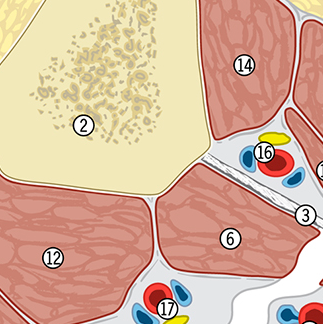
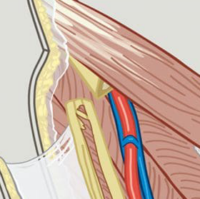
Medical illustration can organize this complexity into a clear visual structure. It can show the defect, the surrounding anatomy, the planned reconstruction, and the final relationship between tissues. It can also reveal deeper structures through controlled transparency, sectional views, or step-by-step sequences.
The goal is not to simplify reconstructive surgery into a generic diagram. The goal is to make complex surgical information understandable without losing anatomical accuracy.
Why reconstructive surgery illustration matters
Reconstructive surgery depends on precision. Small differences in tissue handling, vascular supply, incision placement, or anatomical alignment can influence both function and appearance. In education, publishing, and patient communication, these details need to be communicated clearly.
A well-developed illustration of reconstructive surgery can explain surgical reasoning in ways that raw images often cannot. It can show why a flap is designed in a certain direction, how a graft is positioned, how blood supply is preserved, or how reconstruction restores form and function.
This is valuable for surgical education, journal articles, textbooks, patient information, medico-legal explanation, conference presentations, and interdisciplinary communication. In each case, the illustration should support understanding, trust, and professional clarity.
Reconstructive surgery illustration for surgical education and publications
Surgical education requires clear visual sequencing. A reconstructive procedure is often best understood through a structured series of illustrations rather than through isolated photographs. Medical illustration can show what is exposed, what is moved, what is preserved, and how each step contributes to the reconstructive goal.
For academic publications, surgical atlases, textbooks, and lectures, illustrations of reconstructive surgery can clarify procedures such as flaps, grafts, tissue transfer, scar revision, wound closure, vascular supply, nerve pathways, bone reconstruction, and layered soft-tissue repair.
A strong surgical illustration does more than document a procedure. It explains the anatomical and procedural logic behind it.
Related pages:
→ surgical illustration
→ scientific illustration
From reference material to final illustration
A reconstructive surgery illustration project begins with the communication goal. Before drawing starts, it is important to define what needs to be shown, who the audience is, and where the final visual will be used.
Reference material may include surgical sketches, operative photographs, anatomical literature, imaging, case documentation, publication drafts, or expert input. The concept phase establishes composition, viewpoint, level of detail, and visual emphasis. Once the structure is approved, the final illustration is developed with attention to anatomy, clarity, color, labeling, and format.
- briefing and scope definition
- review of reference material
- concept sketches and visual planning
- illustration development and refinement
- final delivery for publication, presentation, web, or patient education use
A transparent workflow designed for accuracy, clarity, and efficient collaboration.

Facial reconstructive surgery and anatomical sensitivity
Facial reconstructive surgery requires careful visual communication. The face is closely connected to identity, expression, symmetry, and social interaction. Surgical communication in this area must therefore be accurate, refined, and sensitive.
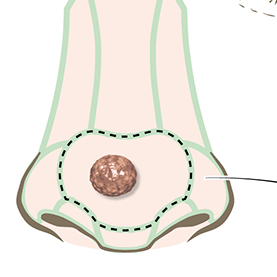
Illustrations can help explain incision planning, tissue movement, flap rotation, closure technique, scar placement, facial nerve relationships, vascular supply, and the connection between structure and appearance. This can be useful for surgical education, patient communication, academic publication, and professional presentation.
The visual style matters. A patient-facing image may need to be calm and accessible, while a specialist publication may require precise anatomical labeling and greater detail. In both cases, the illustration must remain anatomically reliable and visually clear.
Related pages:
→ plastic surgery medical illustration
→ rhinoplasty medical illustration
→ human anatomy illustration
Craniofacial and structural reconstruction
Craniofacial and structural reconstruction often involves complex three-dimensional anatomy. Procedures may include bone repositioning, osteotomy lines, fixation, soft-tissue relationships, growth considerations, or reconstruction after trauma or congenital conditions.
Illustrations can help make these spatial relationships easier to understand. It can show how skeletal structures relate to soft tissue, how fixation is placed, how a defect is reconstructed, or how surgical steps connect to functional and aesthetic goals.
Depending on the project, visuals may be developed as detailed anatomical illustrations, simplified educational diagrams, surgical sequences, or selected 3D-supported visualizations. The technique is always chosen based on the audience, purpose, and level of anatomical complexity.
Related pages:
→ orthopedic medical illustration
→ plastic surgery medical illustration
→ scientific animation visualization
Flaps, grafts, and tissue transfer
Many reconstructive procedures depend on the movement or replacement of tissue. Flaps, grafts, donor sites, vascular pedicles, and recipient areas can be difficult to explain through photography alone, especially when the anatomy is layered or the surgical field is visually complex.
Medical illustration can clarify the differences among a local flap, a regional flap, a free flap, a graft, and tissue rearrangement. It can show the tissue’s origin, the direction of movement, the vascular supply, and the final placement relative to the defect.
This type of visual communication is especially useful in surgical teaching, publication figures, patient education, and interdisciplinary planning. It helps the viewer understand not only what is done, but why the reconstruction works.
About Karin Spijker
I am Karin Spijker, a scientific and medical illustrator with a background in drawing, painting, and textile design. With a master’s in scientific illustration and additional skills in 3D production, I combine accuracy, artistry, and storytelling. My work helps healthcare and publishing teams communicate complex ideas clearly and reliably.
Alongside commissioned projects, I also create independent artworks inspired by nature, anatomy, and landscapes. My mission is to make science and nature accessible, inspiring, and visually engaging.

Reconstructive surgery illustration for patient education
Patients often need clear explanations before they can understand a reconstructive procedure. Medical terminology alone is rarely enough, and operative photography can be confronting or difficult to interpret. Illustration offers a controlled and less overwhelming way to explain the process.
Patient education visuals can show the affected area, the planned reconstruction, tissue movement, or the general surgical principle in a calm, readable way. They can support consultations, brochures, clinic websites, informed consent materials, and follow-up discussions.
The visual language should be accessible without becoming inaccurate. The aim is not to oversimplify surgery, but to help patients understand the procedure more clearly and feel better informed.
Related page:
→ patient education illustration
Reconstructive surgery illustration for medico-legal communication
In some cases, reconstructive surgery visuals may also support medico-legal communication. When trauma, injury, surgical intervention, or postoperative outcome needs to be explained objectively, a clear illustration can help structure complex medical information.
The role of illustration in this context is not to dramatize. It is to clarify anatomy, injury patterns, surgical repair, or reconstructive outcomes in a controlled, evidence-based way. The visual should remain neutral, accurate, and understandable for medical and non-medical audiences.
This type of work requires careful handling of references, terminology, and visual tone.
Related page:
→ medico-legal illustration
Custom reconstructive surgery illustration versus generic visuals
Generic stock images, template visuals, and AI-generated images can sometimes be useful for rough concepts, but they are rarely sufficient for specialized reconstructive surgery communication. Reconstructive procedures are too case-specific, layered, and technically complex to rely on generic diagrams.
Custom reconstructive surgery illustration provides control over viewpoint, anatomical detail, labeling, tone, level of realism, and visual hierarchy. It can be tailored to a specific procedure, publication requirement, patient education need, surgical technique, or professional presentation.
This is especially important when the visual needs to explain flaps, grafts, tissue transfer, vascular supply, facial anatomy, craniofacial structures, reconstructive sequence, or surgical outcome. A generic image may look polished, but still fail to communicate the relevant medical information correctly.
- anatomically accurate surgical visualization
- clear explanation of layered anatomy and tissue movement
- controlled simplification without distortion
- publication-ready quality
- consistent style across larger projects



Techniques and output formats
The technique depends on the goal of the project. Some reconstructive surgery illustrations are best communicated through clean line work or schematic diagrams. Others require detailed digital rendering, layered anatomical views, cross-sections, or selected 3D-supported visualization when spatial relationships need to be explained more clearly.
For scientific publishing, illustrations can be prepared as high-resolution raster or vector artwork. For presentations and patient education, visuals may be adapted for slides, clinic websites, brochures, digital learning materials, or professional communication. When needed, layered files can also support future revisions or related educational adaptations.
The choice of technique is guided by accuracy, audience, final use, and the level of anatomical detail required.
Understanding reconstructive surgery illustration pricing
Reconstructive surgery illustration is custom work. Pricing depends on the complexity of the subject, the number of views, the level of anatomical detail, the intended use, and the licensing scope.
A single explanatory illustration is different from a multi-step surgical sequence or a detailed anatomical plate. A patient education visual may require a different level of detail than a journal figure or textbook illustration. Licensing also matters: visuals used in a single publication have a different scope from visuals used across websites, lectures, printed material, marketing, and long-term educational resources.
After a short intake, I provide a clear quotation with scope, deliverables, timeline, usage rights, and revision structure. This ensures that expectations are clear before production begins.
Why work with Karin Spijker
Reconstructive surgery illustration requires more than general drawing ability. It requires anatomical understanding, visual discipline, surgical awareness, and the ability to translate layered three-dimensional procedures into clear visual communication.
My work combines medical and scientific illustration training with detailed anatomical drawing and a calm, structured visual language. I focus on visuals that are accurate, readable, and professionally prepared for their intended use.
Projects are developed with attention to clarity, collaboration, and usability. Whether the final illustration is intended for surgical education, academic publication, patient communication, medico-legal explanation, or professional presentation, the aim is to create visuals that support understanding and can be used with confidence.
Long-term value of custom reconstructive surgery illustration
A strong illustration of reconstructive surgery can be used beyond a single project. The same visual approach may support journal figures, lectures, clinic education, website content, patient materials, medico-legal explanation, or future teaching resources.
Consistency is especially valuable when multiple illustrations are created for the same publication, clinic, procedure, case series, or educational system. A coherent visual language improves readability, supports learning, and gives the project a more professional appearance.
Custom reconstructive surgery illustration supports clarity, accuracy, credibility, and long-term communication value.
Frequently asked questions
Find answers to common questions about the illustration process, timelines, pricing, licensing, file delivery, and collaboration.
Start your reconstructive surgery illustration project
If you are looking for reconstructive surgery illustration for surgical education, publication, patient communication, medico-legal explanation, clinic materials, or professional presentations, the focus should always be on clarity, accuracy, and usability.
Whether your project involves flaps, grafts, facial reconstruction, craniofacial anatomy, tissue transfer, surgical repair, trauma-related reconstruction, patient education, or a broader surgical communication project, I can help translate complex reconstructive surgery information into visuals that are clear, reliable, and professionally prepared.
→ View related work in the portfolio
→ Get in touch to discuss your project
Translate complex reconstructive surgery into clear visual communication
Work directly with a scientific and medical illustrator to create accurate reconstructive surgery visuals for surgical education, publication, patient communication, medico-legal explanation, or professional presentations.
Ready to collaborate on a reconstructive surgery illustration project?
Clear, accurate, and aligned with your medical content