Avian anatomical accuracy
Illustrations developed from scientific references, veterinary source material, and species-specific bird anatomy.
Clarity for complex avian anatomy
Visuals designed to clearly explain respiratory systems, pneumatic bones, internal organs, skeletal structures, and spatial relationships.
Structured visual communication
A clear workflow from briefing and reference material to final visuals for veterinary education, research, or publication.
Avian anatomy illustration services
Avian anatomy illustration translates the complex structure of birds into clear, accurate visual communication for research, education, veterinary medicine, and scientific publishing. Bird anatomy differs significantly from mammalian anatomy, with specialized respiratory, skeletal, digestive, cardiovascular, and reproductive systems that are often difficult to explain through standard visual material alone.
Because birds are structurally adapted for flight, their anatomy contains relationships that are highly efficient but visually complex. Air sacs, pneumatic bones, fused skeletal elements, specialized digestive organs, and unique respiratory mechanics require careful interpretation. Illustrations can clarify these relationships by organizing anatomical information into visuals that are accurate, readable, and useful for professional communication.
I am Karin Spijker, a certified scientific and medical illustrator with a strong background in anatomy, biological visualization, and detailed observational drawing. I create custom avian anatomy illustrations for veterinary education, scientific publications, research communication, and professional learning materials.
Related pages:
→ animal anatomy illustration
→ comparative anatomy illustration
→ veterinary medical illustration
→ scientific illustration
→ portfolio
“I have worked with Karin Spijker for many years on various visual projects. The greatest common denominator in these projects is a qualitative, professional image delivered on time. Karin is entirely at home in both fields, whether an illustration or high-end image editing on photo material.”
 Pauline Speelman, Signorita
“Karin Spijker has performed assignments for me several times to my complete satisfaction, such as logos and two 3D animations. Karin can translate the information from a briefing into the desired end product and can think along with you pleasantly. In doing so, she works accurately, follows the set timetable, and honors her appointments. Karin is also a charming person to work with.”
 Natasja Kardos, Seahorse Solutions
“For my clients, I have asked Karin Spijker more often for customized assignments, especially for more specialized image editing. Karin can conjure up software like Adobe Photoshop and Illustrator. She is very meticulous and also communicates about progress. I highly recommend Karin, her work, and her pleasant cooperation.”
 Marian de Jong, Piri Piri Marketing en Communicatie
Translating bird anatomy into visual clarity
Avian anatomy requires a different visual approach from mammalian anatomy. Structures are often compact, lightweight, fused, or closely connected to respiratory and movement systems. This can make bird anatomy difficult to communicate clearly through photography, images of dissections, diagnostic scans, or generic stock visuals.
A well-developed illustration of avian anatomy helps clarify what matters most. It can isolate specific structures, simplify visual noise, show internal relationships, and guide the viewer through systems that are otherwise difficult to interpret. This is especially valuable in education, where students need to understand anatomy quickly and accurately, and in scientific publishing, where visual clarity supports interpretation of complex information.
The goal is not to make bird anatomy look simpler than it is. The goal is to make complex structures understandable without losing scientific meaning.
Why avian anatomy illustration matters
Birds have anatomical systems that differ profoundly from those of mammals. Their respiratory system, skeletal structure, digestive system, and reproductive anatomy are highly specialized and closely connected to movement, flight, metabolism, and survival. This makes avian anatomy a rich subject for education and research, but also a challenging one to visualize.
In veterinary and scientific communication, inaccurate or overly generic visuals can easily create misunderstanding. A simplified mammalian model cannot simply be adapted to represent a bird. Important structures such as the air sac system, pneumatic bones, syrinx, crop, proventriculus, ventriculus, cloaca, and fused skeletal elements require species-aware and system-aware visual interpretation.
Custom avian anatomy illustration provides a controlled way to show these structures clearly. It supports learning, professional communication, publication, and clinical explanation by presenting anatomy in a way that is both accurate and visually structured.
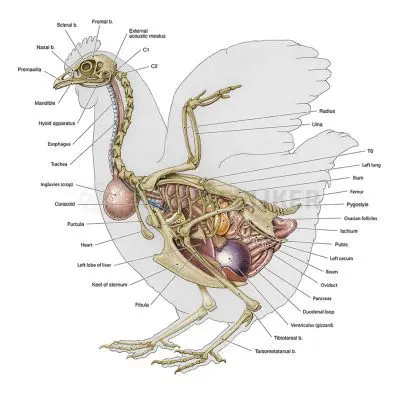
Respiratory anatomy and the air sac system
One of the most distinctive features of bird anatomy is the respiratory system. Unlike mammals, birds use a highly efficient system of air sacs and relatively rigid lungs to support continuous airflow. This system is central to avian physiology and is often difficult to understand through text alone.
Illustration can clarify the spatial relationship between the lungs, air sacs, sternum, coelomic organs, and surrounding skeletal structures. This is especially useful because the air sacs are thin-walled, extensive, and not always easy to visualize in real specimens or standard reference images.
For educational and veterinary communication, avian respiratory illustrations can help explain how airflow moves through the body, how the air sacs relate to other organs, and why this system differs so strongly from mammalian respiration. The visual emphasis can be adjusted depending on whether the audience is a student, researcher, veterinary professional, publisher, or broader educational audience.
From reference material to final illustration
Creating an avian anatomy illustration requires a structured workflow. Each project begins with the communication goal: what needs to be shown, who needs to understand it, and how the final visual will be used.
Reference material may include anatomical literature, veterinary sources, scientific publications, photographs, sketches, imaging data, or expert feedback. The concept phase defines the composition, viewpoint, level of detail, and visual hierarchy. Once the structure is clear, the illustration is developed and refined for accuracy, clarity, and usability.
- briefing and scope definition
- research and reference review
- concept sketches and visual planning
- illustration development and refinement
- final delivery for publication, education, or digital use
A transparent workflow designed for accuracy, clarity, and efficient collaboration.

Pneumatic bones and skeletal specialization
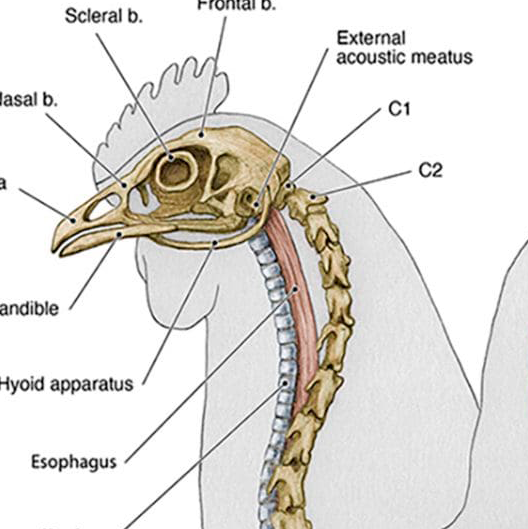
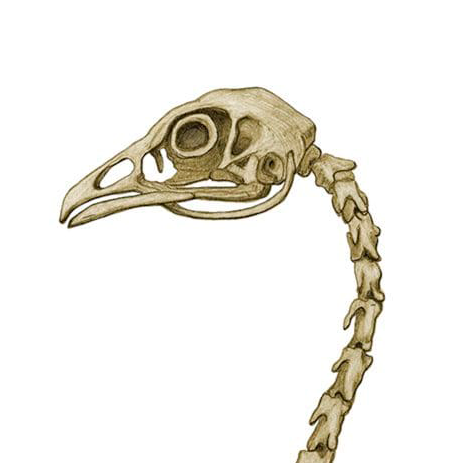
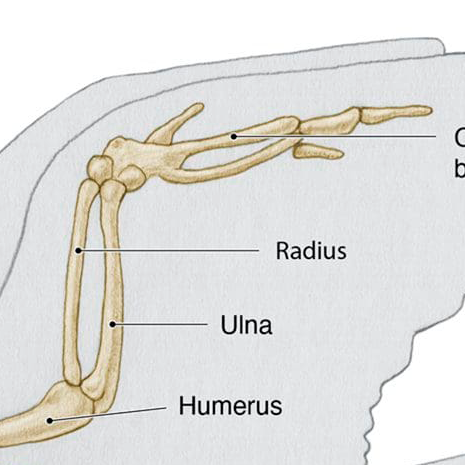
Avian skeletal anatomy is highly specialized. Many birds have lightweight bones, fused skeletal elements, and pneumatic structures connected to the respiratory system. These adaptations support flight and efficient movement, but they also create anatomical relationships that can be difficult to interpret.
A clear illustration of avian anatomy can show how skeletal structures, air spaces, muscles, joints, and internal systems relate to one another. This is useful in veterinary education, comparative anatomy, natural history communication, and scientific publishing.
For example, the relationship between pneumatic bones and the respiratory system may be important in explaining anatomy, disease processes, fracture considerations, or species-specific adaptations. The illustration does not need to show every detail at once. Instead, it should organize the information so the viewer understands the anatomical logic behind the structure.
Related pages:
→ comparative anatomy illustration
→ animal anatomy illustration
Digestive, cardiovascular, and internal anatomy
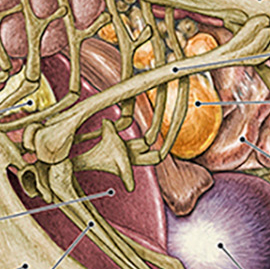
Birds also have highly specialized internal systems. The crop, proventriculus, ventriculus, cloaca, liver, heart, and reproductive structures all occupy a compact internal space where spatial relationships matter. These systems can be difficult to understand when shown only through text, photographs, or isolated diagrams.
Medical and scientific illustration can place these structures in context. It can show how the digestive, respiratory, reproductive, and cardiovascular systems relate to one another inside the body. This is valuable for textbooks, veterinary education, e-learning, museum materials, scientific communication, and professional presentations.
The level of detail can be adapted to the purpose of the visual. Some projects may require a clear educational overview, while others may require more precise anatomical rendering for publication or specialist communication.
Species-specific avian anatomy
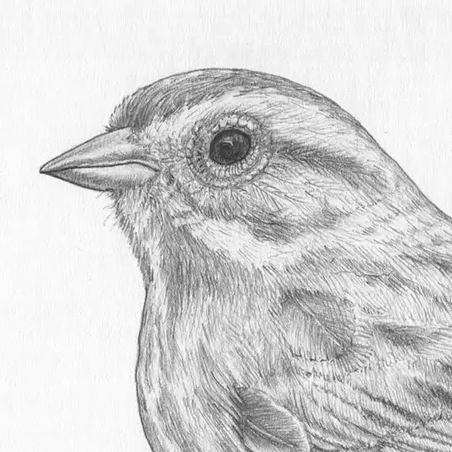
Birds are an extremely diverse group. A general bird anatomy diagram is not always sufficient when the project involves a specific species, group, or functional adaptation. The anatomy of a raptor, parrot, chicken, duck, pigeon, seabird, or small passerine can differ in ways that matter for education, research, or veterinary communication.
Custom avian anatomy illustration allows the visual to be tailored to the species, anatomical region, and communication goal. This may involve reviewing scientific literature, anatomical references, veterinary sources, specimen images, or expert input to ensure that the final visual is accurate and appropriate for the intended use.
This species-specific approach is especially important in comparative anatomy, ornithology, veterinary education, and natural history illustration.
Related pages:
→ natural history illustration
→ biological illustration
→ scientific nature drawing
About Karin Spijker
I am Karin Spijker, a scientific and medical illustrator with a background in drawing, painting, and textile design. With a master’s in scientific illustration and additional skills in 3D production, I combine accuracy, artistry, and storytelling. My work helps healthcare and publishing teams communicate complex ideas clearly and reliably.
Alongside commissioned projects, I also create independent artworks inspired by nature, anatomy, and landscapes. My mission is to make science and nature accessible, inspiring, and visually engaging.

Applications in veterinary education, research, and publishing
- veterinary education and clinical learning
- scientific publications and journal figures
- textbooks, atlases, and educational platforms
- ornithology and natural history communication
- comparative anatomy and evolutionary biology
- patient or client-facing veterinary explanation
A strong avian anatomy illustration functions as more than a decorative image. It becomes a tool for understanding, teaching, and professional communication.
Custom avian anatomy illustration versus generic visuals
Generic stock visuals, template tools, and AI-generated images can be useful for simple or general communication, but they rarely meet the needs of specialized avian anatomy. Bird anatomy contains structures that are easily misunderstood or incorrectly represented when the visual is not based on reliable anatomical source material.
Custom illustration provides control over accuracy, viewpoint, labeling, detail, and visual hierarchy. It also allows the illustration to be adapted to a specific species, educational level, publication format, or clinical communication goal.
- species-specific anatomical accuracy
- clear visual hierarchy and labeling
- controlled simplification without distortion
- publication-ready quality
- consistent style across larger educational or research projects

Understanding avian anatomy illustration pricing
Every project is custom and depends on scope, complexity, and intended usage. If you would like a clear overview of how pricing is structured, including typical ranges and licensing, you can explore the pricing page.
Techniques and output formats
The visual technique depends on the application. Some avian anatomy projects are best communicated through clear line illustration or labeled diagrams. Others may benefit from detailed digital rendering, vector illustration, or selected 3D-supported visualization when spatial relationships need to be explained more clearly.
For scientific publishing, files can be prepared as high-resolution raster or vector artwork. For teaching and digital platforms, illustrations may be adapted for slides, posters, e-learning modules, or online communication. When needed, layered files can also support future revisions or educational adaptations.
The choice of technique is guided by accuracy, audience, and final use.
Work with Karin Spijker
Avian anatomy illustration requires more than drawing skill. It requires anatomical understanding, scientific interpretation, visual discipline, and the ability to translate complex structures into clear communication.
My work combines medical and scientific illustration training with a strong interest in anatomy, animals, nature, and biological form. This makes avian anatomy a natural part of my wider animal anatomy and scientific visualization work.
Projects are developed with attention to accuracy, clarity, collaboration, and usability. Whether the final illustration is intended for education, research, publishing, or veterinary communication, the aim is to create visuals that support understanding and can be used with confidence.
Long-term value of avian anatomy illustration
A well-developed illustration of avian anatomy can become part of a larger educational or scientific communication system. The same visual approach can be adapted across publications, lectures, textbooks, posters, museum displays, e-learning platforms, and future project materials.
Consistency is especially valuable when multiple anatomical systems, species, or illustrations are used together. A coherent visual language improves readability, supports learning, and gives the project a more professional appearance.
Custom avian anatomy illustration supports clarity, reliability, and long-term communication value.
Frequently asked questions
Find answers to common questions about the illustration process, timelines, pricing, licensing, file delivery, and collaboration.
Start your avian anatomy illustration project
If you are looking for avian anatomy illustration for veterinary education, research, publication, or scientific communication, the focus should always be on clarity, accuracy, and usability.
Whether your project involves bird respiratory anatomy, skeletal structures, internal organs, species comparison, or broader educational material, I can help translate complex avian anatomy into visuals that are clear, reliable, and professionally prepared.
→ View related work in the portfolio
→ Get in touch to discuss your project
Translate complex avian anatomy into clear visual communication
Work directly with a scientific and medical illustrator to create accurate visuals of bird anatomy for veterinary education, research, publication, or scientific communication.
Ready to collaborate on an avian illustration project?
Clear, accurate, and aligned with your medical content