Cardiovascular accuracy
Illustrations developed from validated anatomical references and cardiovascular imaging data.
Clarity for complex cardiac communication
Structured visuals designed to explain cardiac anatomy, interventions, and physiological processes.
Publication-ready visualization
Medical visuals created for research, education, clinical communication, and scientific publishing.
Cardiology medical illustration
Cardiology is one of the most complex domains in medicine. The heart is a dynamic, three-dimensional organ, driven by continuous motion, electrical activity, and intricate vascular structures.
When communicating cardiovascular conditions, procedures, or innovations, visual clarity is not optional; it is essential.
Cardiology medical illustrations translate complex cardiac anatomy, pathology, and interventions into precise, scientifically grounded visuals suitable for clinical, educational, and publication use.
At Karin Spijker, the focus is on combining scientific accuracy with visual clarity. The goal is not simplification, but correct interpretation and effective communication of complex medical information.
Related services:
→ medical illustration
→ surgical illustration
→ medico legal illustration
“I have worked with Karin Spijker for many years on various visual projects. The greatest common denominator in these projects is a qualitative, professional image delivered on time. Karin is entirely at home in both fields, whether an illustration or high-end image editing on photo material.”
 Pauline Speelman, Signorita
“Karin Spijker has performed assignments for me several times to my complete satisfaction, such as logos and two 3D animations. Karin can translate the information from a briefing into the desired end product and can think along with you pleasantly. In doing so, she works accurately, follows the set timetable, and honors her appointments. Karin is also a charming person to work with.”
 Natasja Kardos, Seahorse Solutions
“For my clients, I have asked Karin Spijker more often for customized assignments, especially for more specialized image editing. Karin can conjure up software like Adobe Photoshop and Illustrator. She is very meticulous and also communicates about progress. I highly recommend Karin, her work, and her pleasant cooperation.”
 Marian de Jong, Piri Piri Marketing en Communicatie
Making complex cardiac anatomy understandable
Cardiology medical illustration is far more than an aesthetic representation of the heart. It is a structured communication tool designed to clarify highly complex anatomical and physiological information. The cardiovascular system is dynamic, layered, and continuously in motion, involving intricate relationships between chambers, valves, vessels, blood flow, electrical signaling, and surrounding structures.
Raw imaging and diagnostic data often contain more information than can be interpreted quickly or communicated effectively to broader audiences. Medical illustration introduces hierarchy, structure, and selective emphasis. Rather than showing every visible detail, it isolates the anatomical and functional relationships that matter most for the intended purpose.
This is particularly valuable when explaining:
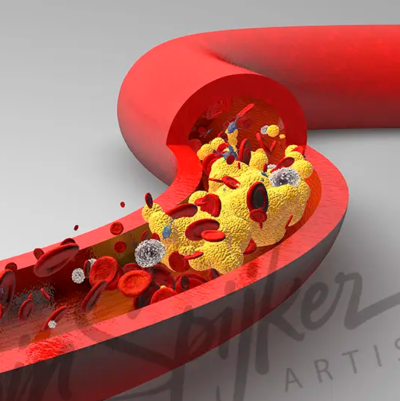
- coronary artery disease and occlusions
- congenital heart defects
- interventional cardiology procedures
- electrophysiology and cardiac rhythm disorders
- valve pathology and surgical repair techniques
- vascular devices such as stents, grafts, and pacemakers
A carefully developed cardiology illustration can communicate in seconds what may otherwise require extensive verbal explanation or interpretation of multiple imaging studies. This improves clarity in research, education, patient communication, and clinical collaboration.
Related:
→ anatomy illustration
→ medical animation
→ biomedical animation
→ scientific animation visualization
The specific challenges of cardiology visualization
Cardiology visualization requires more than general anatomical knowledge. The cardiovascular system combines complex spatial anatomy with continuous movement, pressure dynamics, vascular branching, and highly specialized procedural workflows. Small inaccuracies in anatomy, blood flow direction, or device positioning can lead to major misunderstandings in educational or clinical contexts.
Unlike static anatomical subjects, cardiology often involves processes unfolding over time. Blood circulation, valve mechanics, catheter navigation, and electrical conduction patterns all require careful visual interpretation to communicate accurately. This makes cardiology illustration particularly demanding within medical visualization.
Often, the challenge is not only anatomical accuracy, but also deciding which information should be simplified and which details must remain visible. Effective cardiology visualization balances scientific precision with visual clarity, allowing specialists, students, and non-medical audiences to understand complex relationships more efficiently.
This level of communication is especially important in:
- interventional cardiology
- cardiovascular surgery
- electrophysiology
- scientific publishing
- medical education and e-learning
- patient communication and informed consent
A specialized cardiology medical illustration does not merely depict anatomy. It translates complex cardiovascular information into structured visual understanding.
Workflow: from medical data to final visual
Each project follows a structured and transparent process.
It begins with a focused intake, where the objective, audience, and level of detail are defined. Medical reference materials, such as imaging data and reports, are reviewed.
Concept sketches are developed and refined in collaboration with the client. This ensures alignment between the visual representation and the medical content.
The final illustration is delivered in the required format and resolution, ready for publication, presentation, or clinical use.
A transparent workflow designed for accuracy, clarity, and efficient collaboration.

About Karin Spijker
I am Karin Spijker, a scientific and medical illustrator with a background in drawing, painting, and textile design. With a master’s in scientific illustration and additional skills in 3D production, I combine accuracy, artistry, and storytelling. My work helps healthcare and publishing teams communicate complex ideas clearly and reliably.
My work focuses on translating complex cardiovascular anatomy and medical information into structured visual communication for research, education, and clinical use.
Alongside commissioned projects, I also create independent artworks inspired by nature, anatomy, and landscapes. My mission is to make science and nature accessible, inspiring, and visually engaging.

Scientific impact of visual communication
- clearer interpretation of complex data
- improved communication between specialists
- more effective education
- better patient understanding
In clinical workflows, clear visuals also contribute to efficiency. Preoperative visual alignment ensures that all team members share a common mental model before the intervention.
See also: → patient education illustration
Custom illustration vs stock and AI
When considering cardiology visuals, several alternatives exist. However, the differences are substantial.
Stock platforms offer speed and convenience but rely on generalized anatomy. They are rarely suitable for publication or case-specific communication.
Generative AI can produce visually striking images but lacks a true understanding of anatomy. This often leads to inaccuracies that make the output unreliable for medical use.
|
Feature
|
Custom Medical Illustrations (Karin Spijker)
|
Stock Images / AI Tools
|
|---|---|---|
|
Scientific accuracy
|
Based on validated anatomical and scientific references |
Often generic, outdated, or factually incorrect
|
| Didactic focus | Specifically designed to explain your message | General imagery, often lacking instructional focus |
| Flexibility | Fully adaptable throughout the design process | No or very limited customization |
| Visual consistency | A consistent visual language across materials | Mixed styles from multiple sources |




Understanding cardiology medical illustration pricing
Every project is custom and depends on scope, complexity, and intended usage. If you would like a clear overview of how pricing is structured, including typical ranges and licensing, you can explore the pricing page.
Why professionals choose Karin Spijker
- anatomical relationships are accurate
- medical terminology is applied correctly
- visuals meet international publication standards
- communication remains clear and reliable
Frequently asked questions
Find answers to common questions about the illustration process, timelines, pricing, licensing, file delivery, and collaboration.
Ready to discuss your cardiology project
If you are working on a cardiology-related project and require accurate, high-quality visual communication, you can request a consultation or submit your case.
Whether it involves a scientific publication, surgical procedure, educational module, or device development, the goal remains the same: