Developmental anatomical accuracy
Illustrations developed from verified medical references, neonatal source material, and accurate developmental anatomy.
Clarity for neonatal communication
Visuals designed to explain neonatal anatomy, physiology, procedures, devices, congenital conditions, and parent communication clearly.
Structured visual communication
A clear workflow from briefing and reference material to final visuals for clinical education, publication, parent communication, or training.
Neonatology medical illustration services
Neonatology medical illustration translates complex neonatal anatomy, physiology, procedures, and clinical conditions into clear, accurate visual communication. Neonatal medicine is one of the most sensitive and demanding fields in healthcare. A premature infant or newborn is not a smaller version of an adult. Body proportions, organ development, airway anatomy, circulation, and disease presentation differ significantly and require careful visual interpretation.
In neonatal care, visual clarity matters. Medical professionals need accurate visuals for education, research, publication, and clinical communication. Parents and families often need calm, understandable explanations in emotionally difficult situations. Medical illustration can help bridge these needs by presenting complex information in a structured, accurate, and compassionate way.
I am Karin Spijker, a certified scientific and medical illustrator with a strong background in anatomy, surgical visualization, and detailed drawing. I create custom neonatology medical illustrations for clinical education, scientific publications, patient and parent communication, professional presentations, and healthcare communication.
Related pages:
→ medical illustration
→ patient education illustration
→ scientific illustration
→ portfolio
“I have worked with Karin Spijker for many years on various visual projects. The greatest common denominator in these projects is a qualitative, professional image delivered on time. Karin is entirely at home in both fields, whether an illustration or high-end image editing on photo material.”
 Pauline Speelman, Signorita
“Karin Spijker has performed assignments for me several times to my complete satisfaction, such as logos and two 3D animations. Karin can translate the information from a briefing into the desired end product and can think along with you pleasantly. In doing so, she works accurately, follows the set timetable, and honors her appointments. Karin is also a charming person to work with.”
 Natasja Kardos, Seahorse Solutions
“For my clients, I have asked Karin Spijker more often for customized assignments, especially for more specialized image editing. Karin can conjure up software like Adobe Photoshop and Illustrator. She is very meticulous and also communicates about progress. I highly recommend Karin, her work, and her pleasant cooperation.”
 Marian de Jong, Piri Piri Marketing en Communicatie
Translating neonatal anatomy into visual clarity
Neonatal anatomy requires a careful visual approach. Newborns and premature infants have distinct proportions, developing organs, immature systems, and specific physiological transitions that cannot be accurately represented by adult-based medical visuals.
Photography and imaging can provide important reference material, but they do not always clearly explain the underlying anatomy or clinical processes. Clinical photographs can also be confronting, especially in patient or parent communication. Illustration makes it possible to remove visual noise, show structures in context, and explain what matters most without overwhelming the viewer.
A neonatal medical illustration may clarify body proportions, airway anatomy, umbilical vessels, fetal-to-neonatal circulation, congenital anomalies, organ development, device placement, or clinical procedures. The goal is not to simplify neonatal medicine into generic diagrams. The goal is to make complex neonatal information understandable without losing medical accuracy.
Why neonatology medical illustration matters
Neonatology combines developmental anatomy, physiology, clinical care, and emotional sensitivity. Visual communication in this field must be accurate, calm, and carefully structured. Even small inaccuracies in proportion, anatomy, or physiological relationships can create misunderstanding.
A well-developed neonatology illustration can help medical professionals explain procedures, teach neonatal physiology, clarify congenital conditions, support journal figures, or communicate complex care pathways. It can also help parents understand what is happening to their child in a way that is less confronting than operative or clinical photography.
This makes neonatal illustration valuable for NICU education, pediatric and neonatal training, scientific publishing, patient communication, hospital materials, medical technology, and life science communication. In all of these contexts, the illustration should support understanding, trust, and professional clarity.
Developmental anatomy and neonatal proportions
One of the most important challenges in neonatology illustration is developmental accuracy. A neonate has distinct body proportions, a relatively large head, immature skeletal structures, developing organs, and physiological systems that are still adapting after birth. Premature infants require even more careful interpretation because anatomical and physiological maturity vary with gestational age.
Medical illustration can represent these differences clearly. It can show how neonatal anatomy differs from adult anatomy, how organ systems are positioned, or how anatomical proportions influence clinical procedures. This is especially important when visualizing airway management, vascular access, respiratory support, congenital anomalies, or neonatal circulation.
The visual approach should always be guided by the project’s purpose. A specialist figure for a publication may require detailed anatomical labeling, whereas a parent-facing image may need a calmer, more accessible explanation.
Related pages:
→ human anatomy illustration
→ medical illustration
From reference material to final illustration
A neonatology medical illustration project begins with the communication goal. Before drawing starts, it is important to define what needs to be shown, who the audience is, and where the final visual will be used.
Reference material may include clinical sketches, operative photographs, anatomical literature, imaging, publication drafts, procedural references, device documentation, or expert input. The concept phase establishes composition, viewpoint, level of detail, and visual emphasis. Once the structure is approved, the final illustration is developed with attention to anatomy, clarity, color, labeling, and format.
- briefing and scope definition
- review of reference material
- concept sketches and visual planning
- illustration development and refinement
- final delivery for publication, presentation, web, training, or parent education use
A transparent workflow designed for accuracy, clarity, and efficient collaboration.

Neonatal procedures and clinical education
Neonatal care involves procedures that require precision and careful explanation. For education and training, medical illustration can help clarify procedures such as umbilical catheter placement, neonatal intubation, airway support, vascular access, congenital anomaly repair, respiratory support, or postnatal physiological transition.
These subjects are often difficult to communicate through photography alone. A photograph shows one specific situation, but it may not clearly reveal the anatomical logic behind a procedure. Illustrations can show the relevant structures, remove distractions, and present the sequence in a way that supports learning.
For NICU professionals, pediatric residents, nurses, anesthesiologists, and other healthcare teams, this kind of visual clarity can support training, teaching, and interdisciplinary communication.
Related pages:
→ surgical illustration
→ medical animation
→ scientific animation visualization
Neonatology illustration for scientific publications
Research in neonatology often deals with complex physiological processes, small anatomical structures, emerging therapies, clinical procedures, and highly specific patient populations. Clear visuals can help communicate these topics more effectively in journal articles, review papers, educational supplements, conference presentations, and graphical abstracts.
Medical illustration can clarify methodology, anatomy, mechanisms, clinical pathways, or treatment concepts. It can also help make research more readable by translating complex information into a visual structure that supports interpretation.
For publication use, illustrations can be prepared with appropriate labeling, format, resolution, and visual consistency. The aim is to create figures that support scientific clarity and integrate well with the text.
Related pages:
→ scientific illustration
→ biomedical illustration
Neonatal physiology and transition after birth
The transition from fetal to neonatal life is one of the defining subjects in neonatology. Circulation, breathing, oxygenation, pressure changes, ductal closure, and organ adaptation all change rapidly after birth. These processes can be difficult to explain with words alone.
Illustrations can help illustrate the relationships among fetal circulation, neonatal circulation, lung expansion, oxygen exchange, and cardiovascular adaptation. It can also clarify how developmental immaturity affects clinical care, especially in premature infants.
This type of visual communication is useful for medical education, research presentations, patient communication, and animated explanations. When needed, a static illustration can also be developed into a sequence or animation to show change over time.
Related pages:
→ cardiology medical illustration
→ medical animation
→ scientific animation visualization
About Karin Spijker
I am Karin Spijker, a scientific and medical illustrator with a background in drawing, painting, and textile design. With a master’s in scientific illustration and additional skills in 3D production, I combine accuracy, artistry, and storytelling. My work helps healthcare and publishing teams communicate complex ideas clearly and reliably.
Alongside commissioned projects, I also create independent artworks inspired by nature, anatomy, and landscapes. My mission is to make science and nature accessible, inspiring, and visually engaging.

Congenital anomalies and neonatal conditions
Neonatology often involves congenital anomalies, developmental conditions, and complex anatomical variations. These topics require careful visual handling. The illustration must be accurate enough for professional use, but also sensitive enough for education or parent communication.
Medical illustration can help explain anatomical relationships, surgical planning, disease mechanisms, or the difference between normal and affected anatomy. Depending on the project, the visual may focus on a condition, a procedure, a clinical pathway, or a broader educational overview.
The visual tone matters. Especially in neonatal and parent-facing communication, the goal is to clarify without causing unnecessary distress.
Related pages:
→ patient education illustration
→ surgical illustration
Neonatology illustration for parent communication
Parents in neonatal care are often confronted with highly technical information during a stressful and emotional time. Medical terminology, monitors, procedures, and clinical uncertainty can be overwhelming. A clear illustration can help make information more understandable and less intimidating.
Parent-facing neonatal visuals can explain anatomy, procedures, devices, congenital conditions, respiratory support, circulation, or treatment steps in a calm and structured way. The visual language should be accessible, gentle, and medically accurate.
The aim is not to replace clinical conversation. The aim is to support it. A good illustration gives healthcare professionals a clearer way to explain what is happening and gives parents a visual reference they can return to.
Related page:
→ patient education illustration
Medical devices and neonatal care visualization
Neonatal care often involves specialized devices, lines, tubes, monitors, respiratory support systems, and treatment technologies. These devices interact with small and developing anatomy, which makes accurate visual explanation important.
Medical illustration can clarify how a device is positioned, how it relates to the infant’s anatomy, or how it supports a physiological function. This can be useful for training, product education, patient information, clinical documentation, or life science communication.
For medical technology and healthcare organizations, neonatal visuals can support communication around device use, safety, anatomy, and clinical workflow without relying only on technical diagrams or clinical photography.
Related pages:
→ biomedical illustration
→ medical animation
→ medical illustration


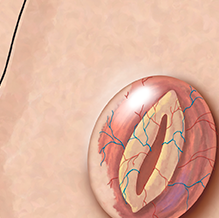
Custom neonatology illustration versus generic visuals
- developmentally accurate neonatal anatomy
- clear explanation of clinical procedures and physiology
- calm and sensitive parent-facing communication
- publication-ready quality
- consistent style across larger educational or research projects
Techniques and output formats
The technique depends on the project’s goal. Some neonatology illustrations are best communicated through clean line work or simplified diagrams. Others require detailed digital rendering, layered anatomical views, cross-sections, schematic figures, or selected 3D-supported visualization when spatial relationships need to be explained more clearly.
For scientific publishing, illustrations can be prepared as high-resolution raster or vector artwork. For presentations, patient education, and training, visuals may be adapted for slides, hospital materials, brochures, digital learning modules, clinic websites, or professional communication. When needed, layered files can also support future revisions or related educational adaptations.
The choice of technique is guided by accuracy, audience, final use, and the level of neonatal detail required.
Understanding neonatology medical illustration pricing
Neonatology medical illustration is custom work. Pricing depends on the complexity of the subject, the number of views, the level of anatomical detail, the intended use, and the licensing scope.
A single explanatory illustration is different from a multi-step clinical sequence, a detailed anatomical plate, a publication figure, or an animation storyboard. A parent education visual may require a different level of detail and tone than a figure in a specialist journal. Licensing also matters: visuals used in one publication have a different scope from visuals used across training materials, websites, lectures, patient brochures, and long-term educational resources.
After a short intake, I provide a clear quotation with scope, deliverables, timeline, usage rights, and revision structure. This ensures that expectations are clear before production begins.
Related page:
→ medical illustration pricing
Why work with Karin Spijker
Neonatology medical illustration requires more than general drawing ability. It requires anatomical understanding, visual discipline, sensitivity, and the ability to translate complex developmental and clinical information into clear visual communication.
My work combines medical and scientific illustration training with detailed anatomical drawing and a calm, structured visual language. I focus on visuals that are accurate, readable, and professionally prepared for their intended use.
Projects are developed with attention to clarity, collaboration, and usability. Whether the final illustration is intended for clinical education, academic publication, parent communication, training material, medical technology, or professional presentation, the aim is to create visuals that support understanding and can be used with confidence.
Long-term value of custom neonatology illustration
A strong neonatology illustration can be used beyond a single project. The same visual approach may support journal figures, lectures, NICU education, parent materials, website content, training resources, or future learning systems.
Consistency is especially valuable when multiple illustrations are created for the same publication, institution, clinical pathway, device, or educational program. A coherent visual language improves readability, supports learning, and gives the project a more professional appearance.
Custom neonatology medical illustration supports clarity, accuracy, sensitivity, credibility, and long-term communication value.
Frequently asked questions
Find answers to common questions about the illustration process, timelines, pricing, licensing, file delivery, and collaboration.
Start your neonatology medical illustration project
If you are looking for neonatology medical illustration for clinical education, publication, parent communication, training materials, life science communication, or professional presentations, the focus should always be on clarity, accuracy, sensitivity, and usability.
Whether your project involves neonatal anatomy, premature infants, airway management, circulation, congenital anomalies, NICU procedures, medical devices, parent education, or broader neonatal communication, I can help translate complex neonatal information into visuals that are clear, reliable, and professionally prepared.
→ View related work in the portfolio
→ Get in touch to discuss your project
Translate complex neonatal medicine into clear visual communication
Work directly with a scientific and medical illustrator to create accurate neonatology visuals for clinical education, publication, parent communication, training, or professional presentations.
Ready to collaborate on a neonatology medical illustration project?
Clear, accurate, and aligned with your medical content