Botanical visual accuracy
Illustrations developed from scientific references, plant material, botanical sources, and species-specific plant characteristics.
Clarity for plant structures and processes
Visuals designed to explain plant morphology, anatomical structures, growth stages, physiological processes, and ecological relationships.
Structured visual communication
A clear workflow from briefing and reference material to final visuals for research, education, publishing, or life science communication.
Botanical illustration services
Botanical illustration translates plant structures, growth patterns, morphology, and biological processes into clear, accurate visual communication. It is used in research, education, publishing, life sciences, natural history, and scientific communication when photography or generic visuals are not sufficient to explain the subject clearly.
A strong botanical illustration is not simply decorative. It can clarify plant anatomy, reproductive structures, diagnostic features, developmental stages, ecological relationships, or physiological processes in a way that supports understanding. By removing visual noise and emphasizing what matters most, illustration makes complex botanical information easier to interpret.
I am Karin Spijker, a certified scientific and medical illustrator with a background in anatomy, biological visualization, and detailed observational drawing. I create custom botanical illustrations for scientific publications, educational materials, natural history communication, research-based projects, and professional visual communication.
Related pages:
→ scientific illustration
→ biological illustration
→ natural history illustration
→ wildlife illustration
→ portfolio
“I have worked with Karin Spijker for many years on various visual projects. The greatest common denominator in these projects is a qualitative, professional image delivered on time. Karin is entirely at home in both fields, whether an illustration or high-end image editing on photo material.”
 Pauline Speelman, Signorita
“Karin Spijker has performed assignments for me several times to my complete satisfaction, such as logos and two 3D animations. Karin can translate the information from a briefing into the desired end product and can think along with you pleasantly. In doing so, she works accurately, follows the set timetable, and honors her appointments. Karin is also a charming person to work with.”
 Natasja Kardos, Seahorse Solutions
“For my clients, I have asked Karin Spijker more often for customized assignments, especially for more specialized image editing. Karin can conjure up software like Adobe Photoshop and Illustrator. She is very meticulous and also communicates about progress. I highly recommend Karin, her work, and her pleasant cooperation.”
 Marian de Jong, Piri Piri Marketing en Communicatie
Translating plant structures into visual clarity
Botanical subjects can be visually complex. Leaves, stems, flowers, roots, seeds, fruit, vascular systems, microscopic structures, and reproductive organs may all need to be understood in relation to one another. A photograph can capture a single specimen at a single moment, but it often includes irregularities, damaged tissue, shadows, reflections, or irrelevant background details.
Illustration allows plant structures to be presented with intention. It can combine multiple observations into a single coherent image, show different life stages together, isolate diagnostic details, or clarify internal and external structures in ways that photography cannot always achieve.
The goal is not to make plant biology look simpler than it is. The goal is to organize botanical complexity into visuals that are accurate, readable, and meaningful.
Why botanical illustration matters
Plants are often visually subtle. Important information may be hidden in small structural differences, venation patterns, reproductive organs, microscopic details, or developmental stages. These details can be essential for taxonomy, education, pharmacognosy, plant biology, ecology, or life science communication.
A well-developed botanical illustration can make these details visible and understandable. It can show what distinguishes one species from another, how a flower’s structure is organized, how a seed develops, or how a physiological process works. In research and publishing, this helps communicate findings more clearly. In education, it helps students understand plant systems that are difficult to interpret from text or photography alone.
This makes botanical illustration valuable as both a scientific tool and an educational communication method.
Scientific accuracy and visual interpretation
Botanical illustration sits at the intersection of observation, science, and visual communication. Accuracy is essential, but accuracy alone is not enough. A technically correct image can still fail if the viewer does not know where to look or how to interpret the information.
Professional botanical illustration combines scientific accuracy with visual hierarchy. Proportions, leaf structure, flower morphology, root systems, seed forms, surface texture, vascular patterns, and microscopic details need to be grounded in reliable references. At the same time, composition, labeling, contrast, simplification, and selective emphasis are used to guide understanding.
This balance is what makes botanical illustration different from general floral art. The image may be visually refined, but the purpose remains communication. Every visual decision should support clarity, interpretation, and scientific reliability.
Botanical illustration for research and publishing
In research and publishing, botanical illustration can function as a precise visual reference. It helps organize complex plant information into a clear structure that supports interpretation, comparison, and documentation.
This is especially valuable in fields such as taxonomy, plant morphology, pharmacognosy, botanical research, ecological studies, and life science publishing. A botanical illustration can clarify features that may be difficult to capture in a single photograph, such as relationships among flower parts, seed arrangements, root structures, microscopic features, or comparisons between species and subspecies.
For publication, illustrations can be prepared with clear labeling, scale information, and technical file formats suitable for journals, books, educational platforms, or digital communication.
Related pages:
→ scientific illustration
→ biological illustration
From reference material to final illustration
Botanical illustration often begins with a mix of source material: photographs, sketches, scientific descriptions, herbarium material, microscopy, plant specimens, literature, or research documents. These sources may contain useful information, but they are rarely ready-made communication tools.
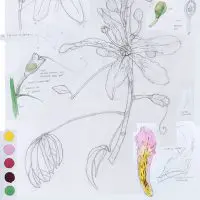
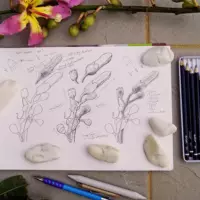
The illustration process translates this material into a clear visual structure. First, the purpose, audience, subject, level of detail, and final use are defined. Then the reference material is reviewed and organized. The concept phase establishes composition, scale, hierarchy, and visual emphasis before the final illustration is developed.
- briefing and scope definition
- research and reference review
- concept sketches and visual planning
- illustration development and refinement
- final delivery for publication, education, or digital use
A transparent workflow designed for accuracy, clarity, and efficient collaboration.

Botanical illustration for education
Botanical illustration is highly useful in education because plant structures and processes can be difficult to understand from text alone. Concepts such as pollination, germination, seed development, plant physiology, photosynthesis, vascular transport, and reproductive anatomy often require visual structure.
Illustrations can reduce complexity by clearly showing the essential elements. It can highlight important parts, remove distracting details, use color logic, and guide the viewer through a process step by step. This makes botanical illustration valuable for textbooks, e-learning modules, educational posters, presentations, museum displays, and university-level teaching materials.
For students and broader audiences alike, clear botanical visuals can make plant science more accessible without sacrificing accuracy.
Related pages:
→ scientific nature drawing
→ natural history illustration
→ patient education illustration
Plant anatomy, morphology, and diagnostic detail
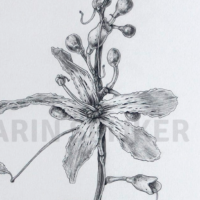
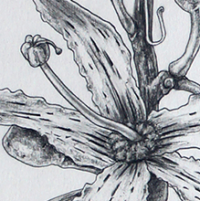
Many botanical projects depend on structural precision. Small details can matter: the shape of a leaf margin, the arrangement of veins, the number and position of reproductive parts, the form of seeds, the structure of roots, or the surface texture of a stem. These details can support identification, classification, comparison, or explanation.
Custom botanical illustration allows these features to be visualized clearly. Instead of showing a single imperfect specimen, the illustration can present an idealized yet scientifically grounded representation of the plant. This makes it useful for scientific documentation, educational material, flora, monographs, field guides, and research communication.
The level of detail can be adapted to the project’s purpose. Some visuals may require a clear educational overview, while others may require precise botanical plates, labeled diagrams, cross-sections, or detailed studies of microscopic structures.
Botanical illustration and ecological communication
Plants rarely exist in isolation. Many botanical subjects are connected to wider ecological systems, including pollinators, habitats, soil, climate, seasonal change, biodiversity, and human impact. In these contexts, botanical illustration can help show relationships that are difficult to explain with separate images or text alone.
A botanical illustration may show how a plant interacts with insects, how a species fits within a habitat, how its life cycle develops over time, or how environmental conditions influence its growth. This makes it useful for conservation communication, museum displays, educational publishing, nature-based storytelling, and ecological science communication.
This connection also naturally links botanical illustration to wildlife and natural history illustration.
Related pages:
→ wildlife illustration
→ natural history illustration
→ scientific nature drawing
About Karin Spijker
I am Karin Spijker, a scientific and medical illustrator with a background in drawing, painting, and textile design. With a master’s in scientific illustration and additional skills in 3D production, I combine accuracy, artistry, and storytelling. My work helps healthcare and publishing teams communicate complex ideas clearly and reliably.
Alongside commissioned projects, I also create independent artworks inspired by nature, anatomy, and landscapes. My mission is to make science and nature accessible, inspiring, and visually engaging.

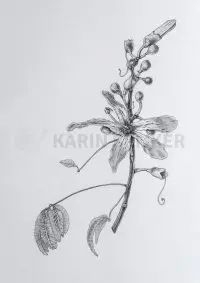
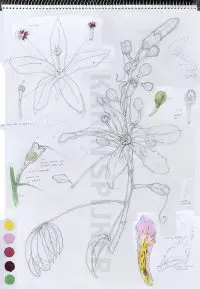
Custom botanical illustration versus photography, stock, and AI
- species-specific visual accuracy
- clear structure and visual hierarchy
- controlled simplification without distortion
- publication-ready quality
- consistent style across larger projects
Understanding botanical illustration pricing
Every project is custom and depends on scope, complexity, and intended usage. If you would like a clear overview of how pricing is structured, including typical ranges and licensing, you can explore the pricing page.
Techniques and output formats
The visual technique depends on the project’s goal. Some botanical illustrations are best communicated through detailed naturalistic rendering. Others require clean line work, labeled diagrams, simplified educational visuals, cross-sections, or vector-based scientific figures.
For scientific publishing, files can be prepared as high-resolution raster or vector artwork. For education and digital communication, illustrations may be adapted for slides, posters, e-learning modules, museum panels, websites, or online platforms. When needed, layered files can also support future revisions or educational adaptations.
The choice of technique is guided by accuracy, audience, final use, and the level of botanical detail required
Botanical illustration, scientific illustration, and fine art
Botanical illustration can serve different purposes depending on context. In scientific and educational settings, the main goal is clarity and reliability. In publishing and museum contexts, the image may also need to be visually refined, engaging, and memorable. In some cases, the same observational foundation can also connect naturally to fine art or collectible nature-based work.
This is an important part of my broader visual direction. My work combines scientific and medical illustration with a strong interest in nature, anatomy, animals, plants, and landscape. Botanical illustration sits naturally between these worlds: it can support research and education while also fostering a wider appreciation of the natural world.
This connection is especially relevant to my broader Nature Artistry direction, where nature, anatomy, botanical forms, and visual storytelling come together in a more artistic context.
Applications in research, education, publishing, and life sciences
Botanical illustration can be used across many professional and educational contexts. It may support a scientific paper, a field guide, a textbook, an educational poster, a museum panel, a conservation project, or a digital learning platform.
In research and publishing, it can clarify plant morphology, anatomical structures, developmental stages, physiological processes, or comparative findings. In education, it can help students and broader audiences better understand plant biology. In life sciences and pharmaceutical contexts, botanical illustration may also support communication around plant-based compounds, medicinal plants, toxic species, or biological mechanisms.
- scientific publications and journal figures
- textbooks, field guides, flora, and atlases
- museum exhibitions and educational displays
- botanical research and taxonomy
- plant physiology and life science communication
- e-learning platforms and teaching materials
Why work with Karin Spijker
Botanical illustration requires more than the ability to draw plants beautifully. It requires observation, structural understanding, scientific interpretation, visual discipline, and the ability to translate complex natural subjects into clear communication.
My work combines medical and scientific illustration training with a strong interest in nature, anatomy, animals, plants, and biological form. This allows me to create visuals that are accurate, refined, and visually engaging without losing their educational or scientific purpose.
Projects are developed with attention to clarity, accuracy, collaboration, and usability. Whether the final illustration is intended for research, education, publishing, museum communication, life sciences, or a broader nature-based project, the aim is to create visuals that support understanding and can be used with confidence.
Long-term value of custom botanical illustration
A well-developed botanical illustration can become part of a larger educational, scientific, or public communication system. The same visual approach can be adapted across publications, posters, lectures, museum displays, e-learning platforms, websites, and future project materials.
Consistency is especially valuable when multiple species, structures, or biological processes are shown together. A coherent visual language improves readability, supports learning, and gives the project a more professional appearance.
Custom botanical illustration supports clarity, reliability, and long-term communication value.
Frequently asked questions
Find answers to common questions about the illustration process, timelines, pricing, licensing, file delivery, and collaboration.
Start your botanical illustration project
If you are looking for botanical illustration for research, education, publishing, life sciences, museum communication, or scientific outreach, the focus should always be on clarity, accuracy, and usability.
Whether your project involves plant morphology, botanical anatomy, growth stages, physiological processes, ecological relationships, medicinal plants, or broader educational material, I can help translate complex botanical information into visuals that are clear, reliable, and professionally prepared.