Anatomical accuracy
Based on verified anatomical references and aligned with current medical standards.
Clarity of complex structures
Complex anatomical relationships are translated into clear, structured visuals.
Purpose-driven visuals
Each illustration is tailored to its context, from education to clinical communication.
Human anatomy illustration services
Human anatomy is inherently complex. Describing the exact course of a nerve, the structure of a joint, or the progression of a condition often exceeds what text alone can communicate.
Human anatomy illustration provides clarity.
As a certified medical and scientific illustrator, I translate complex anatomical and clinical information into precise, structured visuals. These illustrations are designed to support understanding, decision-making, and learning across medical education, publishing, and healthcare communication.
→ Explore related medical illustration services
→ View selected work in the portfolio
“I have worked with Karin Spijker for many years on various visual projects. The greatest common denominator in these projects is a qualitative, professional image delivered on time. Karin is entirely at home in both fields, whether an illustration or high-end image editing on photo material.”
 Pauline Speelman, Signorita
“Karin Spijker has performed assignments for me several times to my complete satisfaction, such as logos and two 3D animations. Karin can translate the information from a briefing into the desired end product and can think along with you pleasantly. In doing so, she works accurately, follows the set timetable, and honors her appointments. Karin is also a charming person to work with.”
 Natasja Kardos, Seahorse Solutions
“For my clients, I have asked Karin Spijker more often for customized assignments, especially for more specialized image editing. Karin can conjure up software like Adobe Photoshop and Illustrator. She is very meticulous and also communicates about progress. I highly recommend Karin, her work, and her pleasant cooperation.”
 Marian de Jong, Piri Piri Marketing en Communicatie
Anatomy illustration for education and publishing
Scientific publishers, universities, and medical training platforms rely on accurate visuals to communicate complex knowledge without compromising scientific integrity.
A high-quality anatomy illustration for medical textbooks acts as a bridge between theory and spatial understanding.
Unlike photography, which often contains visual noise such as overlapping tissue, reflections, or occlusions, illustration allows for greater control over clarity. Relevant anatomical structures can be isolated, relationships emphasized, and unnecessary elements removed.
This results in visuals that:
- Improve comprehension of complex anatomical structures
- Reduce cognitive load in learning environments
- Support long-term retention
- Enhance the quality and authority of publications
For this reason, custom anatomy illustration remains the preferred standard in academic and professional medical publishing.

Detailed anatomical visuals designed for medical education, textbooks, and clinical reference.

Focused illustrations of specific systems such as musculoskeletal, vascular, and nervous structures.

Applied anatomical visuals for surgical planning, procedures, and patient communication.
From scientific complexity to visual understanding
The effectiveness of anatomy illustration is grounded in cognitive science. Research shows that most learners process information more effectively through visual means, especially when dealing with complex spatial relationships.
Well-constructed illustrations reduce the need to mentally reconstruct anatomy from text. Instead, they present information directly and clearly.
In my work, I apply:
- Clear hierarchy and composition
- Selective detail and abstraction
- Color coding and layering (2D and 3D)
- Focus on specific learning objectives
This approach is not decorative; it is functional. It enables faster understanding and more effective knowledge transfer.
Anatomy illustration for patient communication
Communicating medical information to patients requires a different visual strategy than communication between professionals.
Where clinicians need depth and precision, patients need clarity and accessibility.
A well-designed anatomy illustration for patient education:
- Simplifies complex medical information
- Supports informed decision-making
- Reduces uncertainty and anxiety
- Improves overall understanding of procedures and conditions
Visual communication plays a key role in patient comprehension. Clear illustrations help bridge the gap between medical expertise and patient understanding, without compromising accuracy.

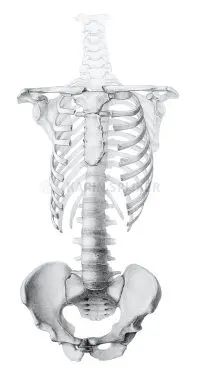
Types of human anatomy illustration
Depending on the context and audience, different approaches are used.
I provide:
- Detailed anatomical illustrations for textbooks and publications
- Simplified diagrams for education and communication
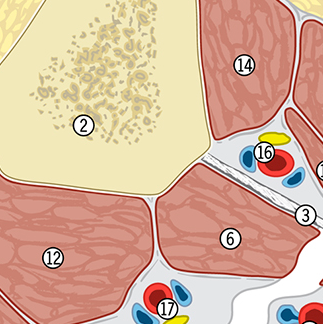
- Cross-sections and layered anatomical views
- Clinical and surgical context illustrations
- 2D and 3D anatomical visualizations
Each illustration is developed with a clear purpose: to communicate anatomy as effectively and accurately as possible.
Custom anatomy illustration vs. generic visuals
Generic images, stock visuals, and AI-generated content can be useful for quick internal use. However, they often fall short in professional medical contexts.
Key differences:
- Scientific accuracy: verified through reference-based research
- Control and specificity: tailored to exact anatomical or clinical needs
- Didactic clarity: focused on a defined learning objective
- Licensing: suitable for professional and long-term use
For high-stakes applications such as medical textbooks, surgical communication, or patient education, accuracy and clarity are essential. Custom illustration ensures both.

Why work with a professional anatomical illustrator
Anatomical illustration goes beyond drawing skill. It requires a deep understanding of anatomy, clear visual communication, and close collaboration with medical professionals.
About Karin Spijker
I am Karin Spijker, a scientific and medical illustrator specialized in human anatomy. With a background in drawing, painting, and a master’s degree in scientific illustration, I combine anatomical accuracy with clear visual communication.
My work supports publishers, healthcare professionals, and educational platforms in translating complex anatomical structures into precise and understandable visuals.
Alongside commissioned projects, I also develop independent work focused on anatomy and nature. This ongoing practice strengthens my observational skills and deepens my understanding of form, structure, and visual clarity.

Selected anatomy illustration work
Each project is developed in close collaboration with clients, including publishers, healthcare organizations, and life sciences companies.
Explore selected examples of human anatomy illustration to see how complex medical information is translated into clear, functional visuals.


Understanding medical illustration pricing
Every project is custom and depends on scope, complexity, and intended usage. If you would like a clear overview of how pricing is structured, including typical ranges and licensing, you can explore the pricing page.
Frequently asked questions
Find answers to common questions about the illustration process, timelines, pricing, licensing, file delivery, and collaboration.
Request a quote or discuss your project
Looking for a professional human anatomy illustrator for medical or educational projects?
I work with publishers, healthcare organizations, and life sciences companies to develop custom, high-quality anatomical illustrations tailored to specific goals and audiences.
Get in touch to discuss your project or request a tailored quote.